
MA STUDIOS is a two-year Master’s program for dance makers and performers interested in a research-based studio practice in contemporary dance and choreography. On these pages, you can find more information about the program and how to apply. The application process opens on January 15.
MA STUDIOS 2026-28
MA STUDIOS is a two-year Master’s program for dance makers and performers interested in a research-based studio practice in contemporary dance and choreography. We consider contemporary dance as an open-ended field in continuous development, embracing transnational practices that seek diverse expressions, meanings, and values. More than an enclosed space for developing skills and experiments, studio practice opens onto the messy realities beyond its walls. In a similarly generative sense, choreography is the grammar underlying the movement of bodies within environments.
For its third edition (2026–2028), MA STUDIOS will explore relational and environmental dimensions of collaboration—understood not only as integral to every creative process but also, in a broader sense, as a site for social and political in(ter)vention.
We take a broad and multifaceted view of collaboration as:
• Sharing authorship and ownership across diverse roles within a project or working context;
• Generously studying together and exchanging resources, skills, knowledge, time and space;
• Cooperating within the institutional framework of P.A.R.T.S., related institutions, the landscape in Brussels and beyond;
• Taking collective responsibility for everyone’s well-being.
How do we navigate differences in capacities, experiences and lineages in order to enrich an ecosystem of artistic work and collective study in dance, as well as the society in which it is embedded? This challenge forms the basis of a pedagogical experiment: PARTS invites applicants who are already working together or seeking new alliances to apply to a program that aims at collaborative outcomes.
THEMATIC LINES OF INQUIRY
This edition offers a timely focus on creative processes that extend beyond the horizon of the individual artist as single author. It invites research and reflection along several interconnected notions and questions:
Relations > physical, material, social, historical, environmental, mutual, multiple—that condition, sustain, mediate, or emerge from an artistic practice, even when it appears to carry an individual signature.
Ecosystem > a dynamic context in which people, materials, places, times, and more-than-human entities are interdependent and interact in complex ways; a space where individuals not only act, but also support, hold space for, or serve as a resource for both human and non-human endeavors; where skills, resources, and energies are exchanged and circulated rather than exploited and exhausted.
Lineage > an attentiveness to divergent lines of descent, where exploring the past may shape a potential history within an unfinished present.
Potentials of a ‘we’ > what becomes possible insofar as we do not act alone?
As a frame for the program, these lines of thought offer a broad framework—rather than a strict theme—within which participants and guest artists can shape their own trajectories. They are meant to leave plenty of room for participants to explore their own directions and shape their collaborations in ways that are artistically and socially fruitful to them.
FACILITIES
P.A.R.T.S. is located in Forest, housed in premises shared with the dance company Rosas and the contemporary music ensemble Ictus, with whom it also collaborates and shares resources. The building includes the Rosas Performance Space, which regularly hosts dance performances in Brussels.
For the MA STUDIOS program P.A.R.T.S. provides three brand new (2025) dedicated studio spaces. The campus provides a vibrant social and artistic context and opportunities for collaboration and exchange. P.A.R.T.S. organises the BA Training programme (40 students) actively collaborates with the partners on campus such as Rosas, Ictus, Platform K, Accompany class, Workspace Brussels and others.
P.A.R.T.S. also has strong connections and partnerships with cultural venues and the artistic scene in Brussels and Belgium. The program includes shorter and longer working periods in other institutions, as well as a longer study trip outside Europe.
PREVIOUS GUEST TEACHERS
To give you an idea of the scope and diversity of approaches and activities, here is a list of guests P.A.R.T.S. has engaged in its past two editions of MA STUDIOS: Patrick Acogny, Sulaiman Addonia, Funmi Adewole, Eylül Akinci, Antoni Androulakis, Mamadou Baldé, Douglas Becker, Nacera Belaza, Nadia Beugré, Thomas Bîrzan, Michelle Boulé, Jonathan Burrows, Luanda Casella, Chloé Chignell, Bojana Cvejić, Farid Dadough-Guebas, Thomas DeFrantz, Thibault De Meyer, Christine De Smedt, Vinciane Despret, Kattrin Deufert, Ntone Edjabe, Mette Edvardsen, Tom Engels, Begüm Ercyias, Laia Escandell, Alix Eynaudi, Panaibra Gabriel Canda, Aminata Gaye, Marie Goudot, Axel Guerin, Thomas Hauert, Adrian Heathfield, David Hernandez, Stephen Howard, Mette Ingvartsen, Kyoko Iwaki, Anne Juren, Hardo Ka, Anneleen Keppens, Youness Khoukhou, Liz Kinoshita, Latifa Lâabissi, Rudi Laermans, Faustin Linyekula, Diane Madden, Kopano Maroga, Fabrice Mazliah, Ogutu Muraya, Eroca Nicols, Alva Noé, Eoghan O'Kelley, Qudus Onikeku, Pol Pi, Amanda Pina, Thomas Plischke, Gilles Polet, Michael Pomero, Nina Power, Jason Respilieux, Dorcy Rugamba, Latifa Saber, Bertrand Saky, Salva Sanchis, Manon Santkin, Gabriel Schenker, Alesandra Seutin, Thierno Seydou Sall, Kirstie Simson, Milo Slayers, Femke Snelting, Alma Söderberg, Rakesh Sukesh, Anya Topolski, Cheikh Oumar Cyrille Touré, Petra Van Brabandt, Myriam Van Imschoot, Michiel Vandevelde, Karen Verlinden, Ise Verstegen, Ingrid Vranken, Rama Wade, Georg Weinand, Samuel Wentz, Ben Woodard, David Zambrano
PLEASE NOTE
At P.A.R.T.S., we believe that education shapes the field of dance and society at large just as much as the professionals within it. For that reason, we are committed to the ongoing and often difficult work of recognizing and combating racism, classism, ableism, sexism, and transphobia. We strive for an atmosphere of curiosity and to build trust among everyone whose efforts contribute to making the program more equitable and open to experimentation. Please also read our Call for Change.
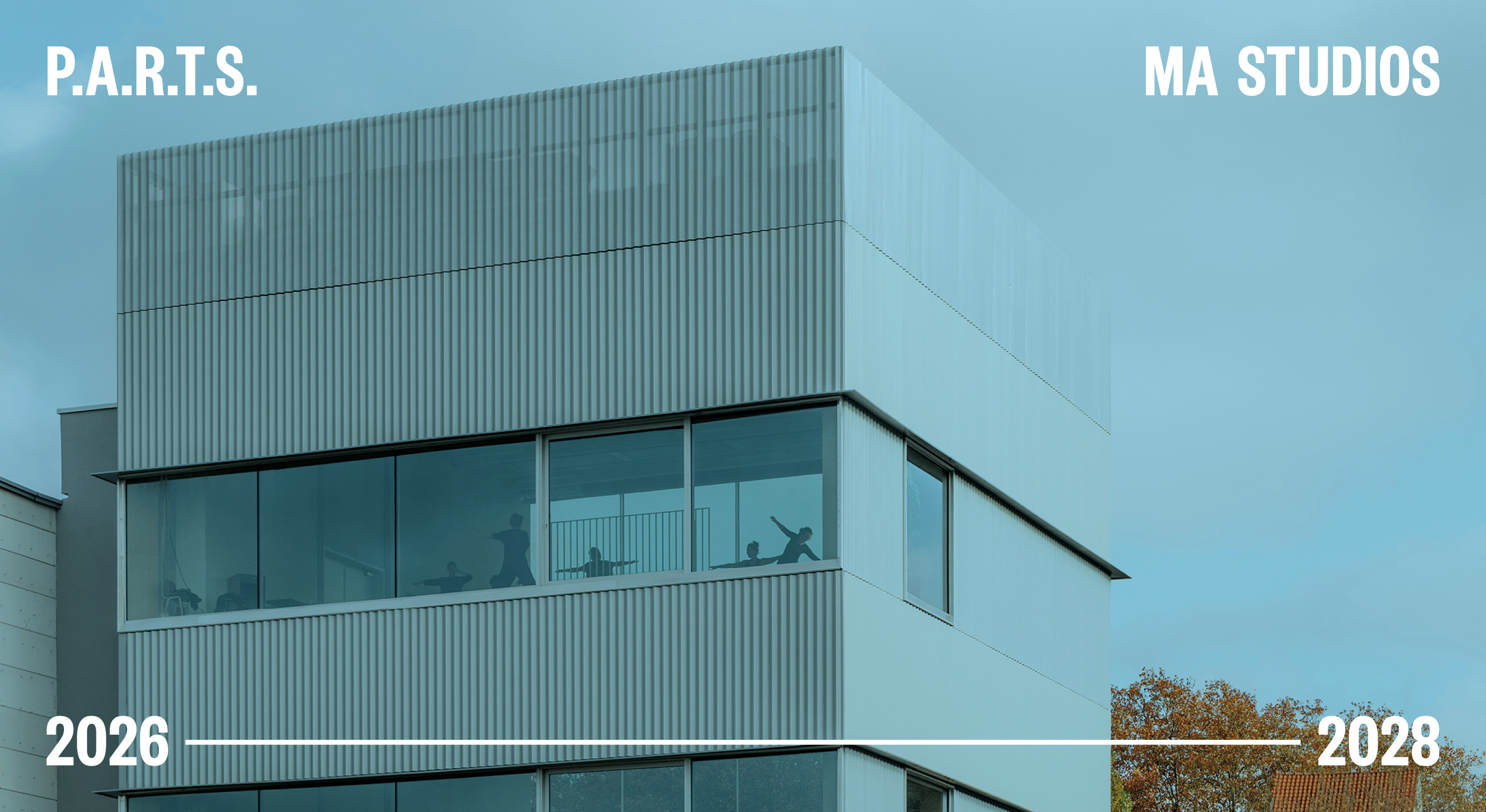
Photo Corentin Haubruge / Ouest. Graphic design Paul Boudens