
RETHINKING CHOREOGRAPHY
On 16 December, a short symposium led by choreographer Jonathan Burrows, neuroscientist and former dancer Guido Orgs and dramaturg and theorist Bojana Cvejić will take place at P.A.R.T.S.
The symposium will introduce their ongoing research into the relationship between neural sequencing and the complex, intuitive movement sequencing of dancers. The programme will feature three lectures, followed by a panel discussion with additional guests Funmi Adewole Elliott, Subathra Subramaniam and Deliah Seefluth.
The idea of the project is to investigate the possibility that choreography might be a 'felt sense' of movement, rather than something which comes from the outside to organise the body. The speculative goal of the work is to ask the question: "What if everybody who dances is already choreographing?" This idea resonates with how younger dance artists are working more fluidly between set and improvised materials, often in situations where everyone taking part is already involved in choreographic decision-making.
The symposium offers an opportunity to think about movement in new ways, drawing upon knowledge of how brain sequencing influences movement, music, language and perception. The research also explores the social implications of this, and the ways in which shared sequencing allows us to dance together in ways that are essential to social cohesion and collective action. Finally, these ideas suggest new ways to question and expand somatic approaches, by giving motor experiences equal importance to sensory input.
This symposium is for anyone interested in how dance movement works, what the roots of choreography might be, and the possibilities of interdisciplinary research between dance and neuroscience.
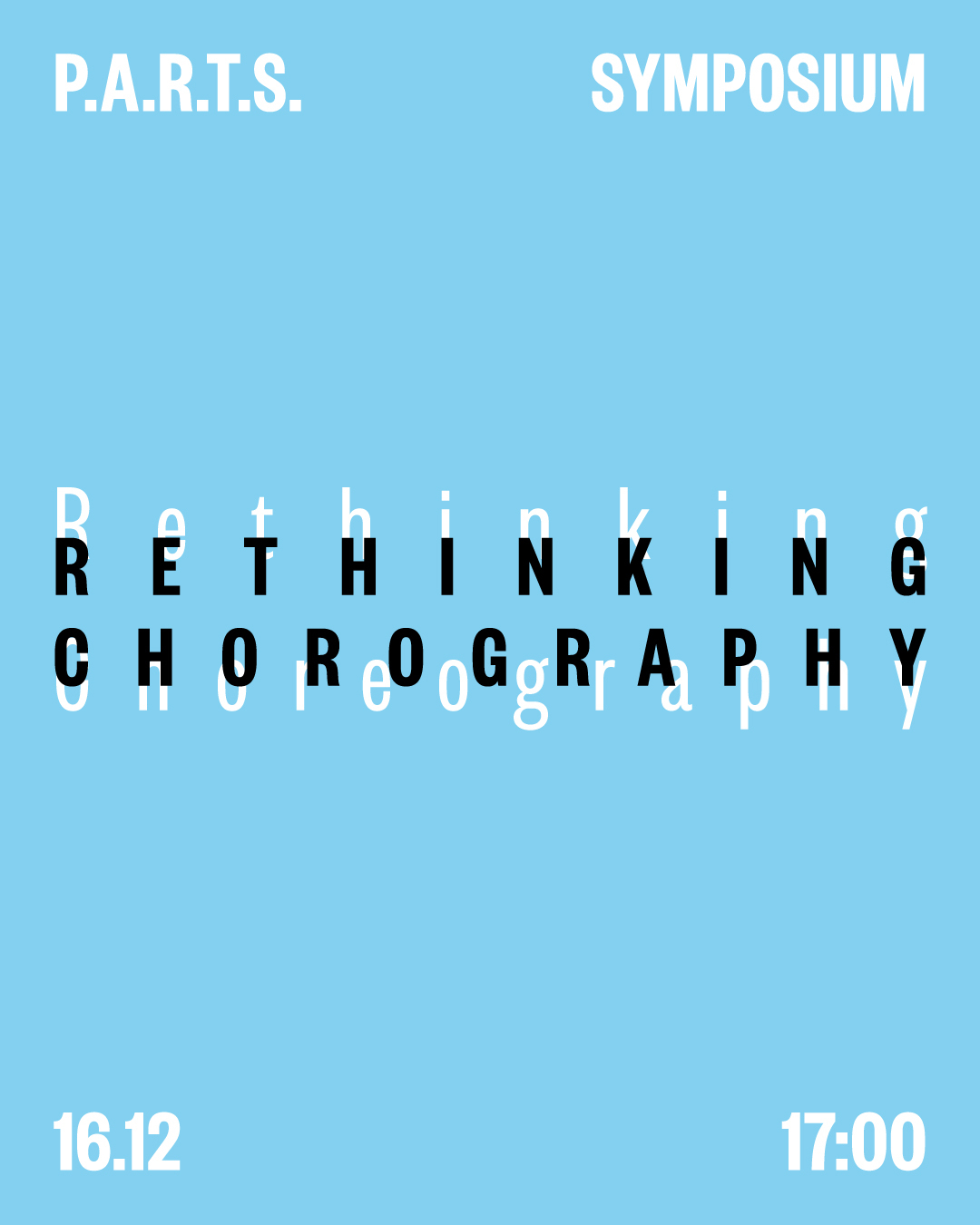
WEDNESDAY 16.12 | 17:00
Entry: €5. Free for students.
Your ticket includes a light snack of bread and soup. A bar will also be available, where you can purchase drinks.
The symposium starts at 17:00 and finishes at 21:15.
Get your ticket HERE.
SPEAKERS and GUESTS
Jonathan Burrows is a choreographer best known for his long interdisciplinary collaboration with composer Matteo Fargion, with whom he has created a series of duets performed across 37 countries. He is an Associate Professor at the Centre for Dance Research at Coventry University, which has supported this research. Jonathan has regularly taught choreographic workshops at P.A.R.T.S. since the school opened.
Guido Orgs is Professor of Cognitive Neuroscience at the Institute of Cognitive Neuroscience, University College London, where he leads the Movement and Performance research group. Guido previously studied contemporary dance at the Folkwang University of the Arts in Essen, Germany, and was a professional dancer with the German dance company NEUER TANZ. From 2020 to 2025, Guido led NEUROLIVE, a five-year EU-funded research project that combined artistic research in performance-making with cognitive neuroscience methods to study how audiences experience live dance.
Bojana Cvejić is a leading dance dramaturge and theorist who has worked closely with Anne Teresa De Keersmaeker, Mette Ingvartsen and Xavier Le Roy, among others. She is the author of influential books such as Choreographing Problems (Palgrave Macmillan, 2015), Towards A Trans-Individual Self (with Ana Vujanović, Khio/SARMA, 2022) and Dramaturgy At Work (Routledge, 2026). Bojana is Professor of Dance and Dance Theory at KHiO Oslo and has taught theory at P.A.R.T.S. since 2002.
Funmi Adewole Elliott is a performer and dance practitioner. She has just premiered a new solo In a city, near a forest which choreographically explores Juju dance and music, and has recently worked as dramaturge on Alessandra Seutin's Ceci n’est pas Noire: Act II at KVS Brussels. Her research-informed practice, Sere Kinaesthetic™ foregrounds ‘play’ and kinaesthetic experience, investigating the intersections between contemporary choreography, storytelling and social dancing. She designs and delivers practical workshops, lectures and labs for conservatoires, universities and professional development organisations and has worked with organisations across Europe, Canada and Africa. After relocating from Nigeria to England in 1994, she performed for 10 years. Her touring credits include productions with Horse and Bamboo Mask and Puppetry, Ritual Arts, Adzido Pan-African Dance Ensemble, Banner Theatre and The Cholmondeleys. She then spent eight years teaching Dance at De Montfort University before returning to industry in 2025. Her academic journey spans an MA in Postcolonial Studies, a PhD in Dance Studies, and a Professional Certificate in Education.
Subathra Subramaniam is a choreographer and educator working at the confluence of dance, culture and science. She spent over 20 years as Artistic Director of two South Asian dance companies, Angika and Sadhana Dance, and is now Artistic Director and Joint-CEO of Akādemi, an organisation promoting and producing South East Asian dance in the UK. Suba creates performance work for theatres, festivals and alternative spaces Her work is a result of in-depth cross art collaborations with artists alongside extensive research undertaken with scientists and academic institutions.
Deliah Seefluth trained as a dancer and dance pedagogue at Iwanson International (Munich) and Peridance Capezio Center (New York), before completing an MA in Choreography and an MSc in Dance Science at Trinity Laban, London. As a dancer, choreographer and educator she has presented work at festivals including Resolution and Move It!, developed interdisciplinary art projects, taught at Trinity Laban and delivered guest classes at the University of Tübingen. Her research interests span performance psychology and the cognitive neuroscience of dance and movement. She researched movement awareness at the Metamotor Lab, University of Tübingen, and is currently pursuing a PhD in the Movement and Performance group at the Institute of Cognitive Neuroscience University College London, investigating the impact of dance on cognitive and mental health.