YOGA | PILATES | BODY STUDIES
Yoga by Cassandre Cantillon
Designed as a moving meditation, Vinyasa yoga is a dynamic and fluid style of yoga that emphasizes the synchronization of movement and breath with a sequence of poses. Through the class, we’ll explore progressive asanas sequences, mobility principles, breathwork exercises and meditation tools. The aim is to offer a physical and mental anchoring point while developing strength, functional flexibility, balance and ultimately foster a sense of quietness to the mind.
Body Conditioning by Charlotte Cétaire
This Body Conditioning class will introduce strength work as a physical preparation specifically for dancers. We will see how this practice can sustain dancers' practice in the short and long term. Indeed, the dancing body is as artistic as well as sportive and we need to develop healthy joints and tissues to sustain the rhythm of a performer's daily life (performing period, sustaining a daily practice during empty times, dealing with injuries, ...). We will learn how to use kettlebells, elastics, bars and rings but also through bodyweight movement. At some point we will dedicate time to analyse dance performances and try to understand which specific physical preparation can be found. The class takes its source in modern sport and medical studies as much as from the teacher's experience as a dancer.
Pilates by Chloe Chignell
This class approaches Pilates as a method for refining movement efficiency in the dancing body. Through slow, precise work, dancers retrain biomechanics and develop greater control of joint articulation. Attention is placed on how movement is initiated, supported, and coordinated through the body. Exercises focus on deep muscular conditioning, spinal organisation, and the relationship between stability and mobility. By working with isolation and integration of joints and muscle groups, participants increase range of motion and flexibility while maintaining structural support. The class also engages with experiential anatomy: sensing, testing, and understanding how muscles and joints function in practice. The aim is to cultivate clarity, control, and adaptability in movement, supporting sustainable physical practice for dancers.
Yoga by Michael Helland
Flying Into Low: Michael Helland offers a week of revitalizing yoga practices to help us arrive ever more fully into the here and now, anchoring through our unfolding sensations and drawing nourishment from our breath, while opening more fully towards presence. Diving into dynamic flows to discover fresh pockets of vibrancy and peacefulness within the sanctuary of our bodies and minds, we will become more aware of what moves us as we endeavor to fly free and flow with ease in the dance of life. After flying so high, we come full circle, drawing from yin and restorative care-based modalities to practice mindful gentle landings.
Yoga by Nilofaur Shahisavandi
This class will give everybody the opportunity to review the base of different asanas and their important actions. The aim is to help you to discover a deeper physical and mental understanding of the asanas and their effects on body, mind and soul. Please feel free to share your interest and questions during the class for adapting the practice to your needs.
Yoga by Silvia Ubieta
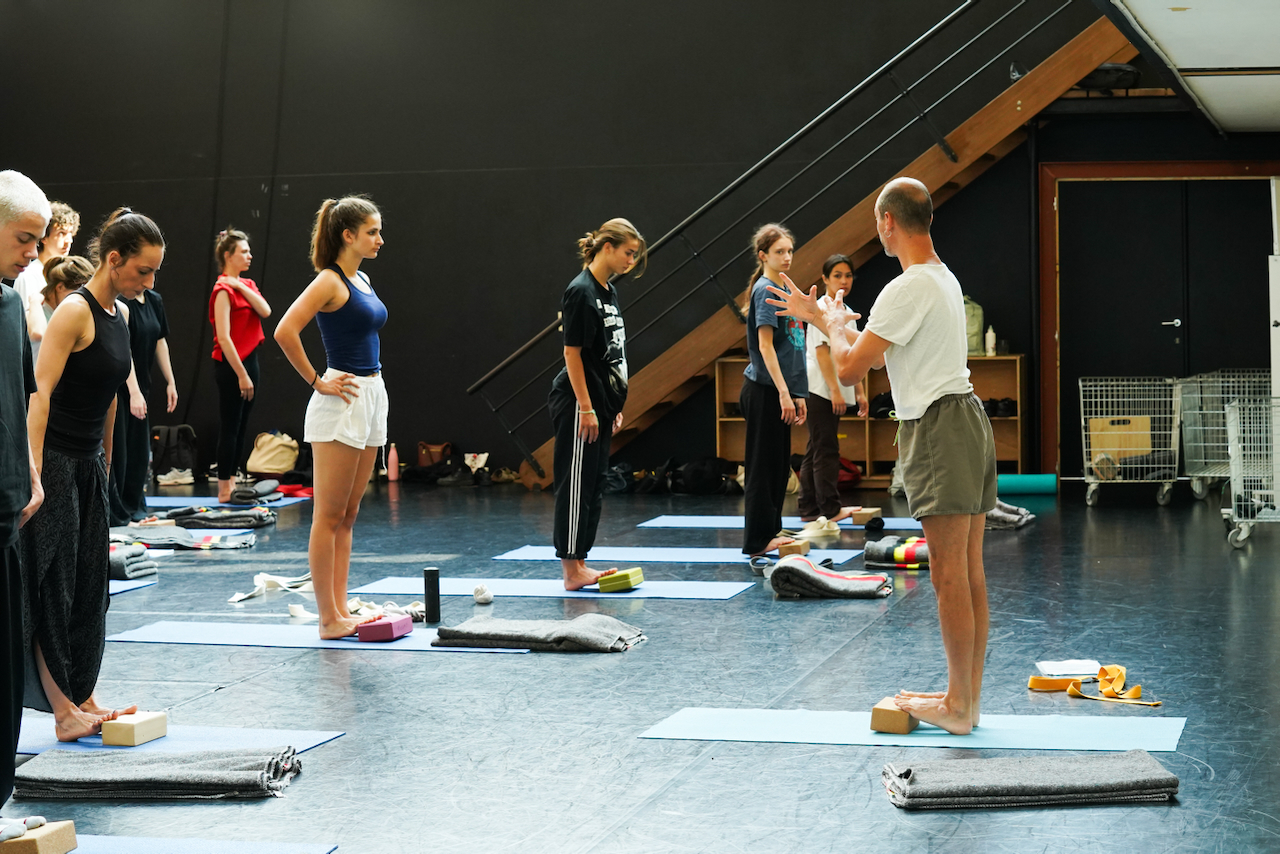
My work is based in Iyengar yoga practice and orientated to the dancer’s body. The practice of the asanas is designed to reinforce the alignment of the body, increase flexibility, and strengthen muscles and connective tissue. During the practice of asanas, the object of concentration is the body, the breathing and the mind. The student focuses his mind on the incoming and outgoing breaths, the steady flexion and extension of different muscle groups and bodily sensations, using the skin as an information receiver to bring awareness. I will focus the practice on extensions and expansion by the sense of directions on different body parts and related to the space around us: floor and air as a support for a better understanding of the pose. At the same time with the practice the epidermal, digestive, lymphatic, cardiovascular, and pulmonary systems are purified of toxins and waste matter; the nervous and endocrine systems are balanced; and brain cells are nourished and stimulated. The result is increased mental clarity, emotional stability, and a greater sense of overall well-being. We will use props: blankets, belts, books and chairs to get proper alignment. The practice will be progressive during the week. The first days I will focus on standing, seated and balancing poses, studying the pelvis area and lower body. At the middle of the week, I’ll start focusing on the spin and upper body, opening the chest and shoulders on twist and backbend poses.
Yoga by Stéphane Bourhis
The teaching of Yoga following the BKS Iyengar methodology is based in depth practice of yoga postures and pranayama (art of breathing), with rigorously, intensity and precision of the body alignments. During the class we gradually explore the outer and the inner geometry of the body in different groups of postures and movements.
CONTEMPORARY
Contemporary technique by Alesandra Seutin
A dancer full of grace and power, Alesandra Seutin is an internationally recognised artist, renowned for her distinctive hybrid movement language. Embracing the idea that individuals have the power to live in movement and to express themselves boldly, she guides you to dance from the inside out. Each day, this 90-minute class offers a dynamic and embodied journey through grounding, fluidity of the spine, and musicality. Drawing from the Acogny Technique, a codified African modern dance form rooted in the traditions of West Africa, participants will develop embodiment, collective movement, rhythmic precision, and expressive freedom. Through undulations, spirals, and polyphonic rhythms, you will be invited to fully inhabit your body, let the breath circulate, and connect to the visible and invisible forces that move through you. Fun, energising, and deeply sensorial, the class engages all senses, emotions, and expressions to the sounds of a live musician. Be prepared to dance and vocalise as you move.
Contemporary technique by Cassandre Cantillon
Through the class, the aim is to create an internal and external environment for physical learning and exploration.
We will explore conditioning tools and practices, coordination work, set material as well as improvisation tasks in order to bring precision, clarity and diversity to our dance and the practices that support it.
Contemporary technique by Clinton Stringer
Movement - from subtle shifts of weight to expansive movement with the whole body. Clinton Stringer (Rosas rehearsal director) will guide this class for beginners. We will start with a few “body discoveries”, exploring weight, direction and alignment. This will be followed by a series of simple exercises which will take these discoveries into movement. The class will finish either with improvisational tasks or the learning of a dance phrase to get the blood pumping!
Contemporary technique by David Hernandez
Dynamic Movement Systems is a technique class with an emphasis on weight, falling, redirecting energy, accentuating sensations of unfamiliar co-ordinations and torsions. Rhythm and accents awaken the neuromuscular abilities of the body towards virtuosity, precision and articulation that challenge the dancer’s habitual movement patterns. The exercises or etudes encourage an emphasis on universal laws of motion and reveal motion itself rather than shape and gestures. The gradual training from floor to standing to travelling and jumping constitute a thorough workout that by the end of the class leaves a taste of ‘everything is possible’ in a vibrant body. More importantly, the class is building a practice in motion with useful technical tips for long and healthy dancing, encouraging the dancer to get to know their body and expand its fitness level as well as its creative capacity.
Urban contemporary technique by Fouad Nafili
In this class, I propose a physical and musical approach to movement, rooted in the deconstruction of techniques shaped by my background in urban dance—particularly Breaking—alongside my choreographic research and performance experience. The class focuses on how these tools and skills are embodied, transformed, and reinterpreted by each participant, while also addressing their origins, context, and underlying principles. Throughout the week, participants will engage with phrases, concepts, drills, andgames adapted to different levels of experience. The work unfolds progressively, allowing space for the integration of new material through guided improvisation, practicing with hip-hop music as a structural framework for timing, energy, composition, and group choreographic scores. Participants are invited to explore performance within shifting sound atmospheres, uncovering diverse relationships in composition, movement, sound, and space.
Contemporary technique by Jason Respilieux
In this class we will give attention to our methods of perception. Through improvisational exercises, instant composition and phrase work, we will investigate how to access and navigate our sensations in parallel to our functional, mechanical and anatomical bodies. How can my impulses or external stimuli inform my body and mind? How can my affects become a translatable movement language ? A search for the specificity and singularity of one's body in relation to the group and tasks at hands. The class develops slowly to prepare the body, the mind, and your whole being to move more consciously. It aims to investigate your personal expression within a shared space of exploration within a clear evolutive frame of work.
Contemporary technique by Laura Aris
In this contemporary dance class, we revisit fundamental technical elements such as weight transfer, spatial awareness, breath, and the diverse qualities and textures of movement. We examine how intention informs precision, recognizing that the basics contain depth and complexity. The aim is both to reset and to advance, reinforcing a solid foundation for further growth. The class focuses on the physical mechanisms that allow us to take risks safely, through a clearer understanding of skeletal alignment, joint organization, and muscular chains. By refining coordination and efficiency, dancers can access greater fluidity, dynamic range, and energy conservation. Metaphors and imagery are used to stimulate new kinesthetic experiences and deepen body awareness. The class structure alternates between set phrases and improvisational tasks within defined frameworks. This balance supports technical clarity while encouraging adaptability, responsiveness, thinking-in-action and individual exploration.
Contemporary technique by Laura-Maria Poletti
In this class we will try to physically understand how to get ready for anything. We will approach technique as a constant reassessment of what is available now and now and now and now. Technique as an ongoing process of adaptation to new challenges. We will explore through improvisation and phrase work how to not shy away from virtuosic and banal movements in a light and play: full way.
Contemporary technique by Marie Goudot
This class focuses on developing movement awareness through attention to space, the body, and the group. Participants will engage in a series of exercises designed to expand peripheral vision and deepen their awareness of their body in motion, as well as the movement of others within the space. Through guided practices, students will explore adaptability, responsiveness, and spatial sensitivity. Emphasis is placed on perceiving and processing multiple layers of information at once—internal sensations, external dynamics, and shifting group configurations.
Contemporary technique by Marita Schwanke
Working with the underlying principles of Taiji, we will investigate how to enter dancing from a place of softness and receptivity, and how to cultivate strength from within rather than relying solely on muscular effort. We will also engage with anatomical perspectives, focusing on our organs, fascia, and meridian channels, to understand how these systems can support our dancing and deepen our relationship to the space around us. The class includes partnering, touch, self-exploration, stillness, and plenty of dancing.
Contemporary technique by Vittoria de Ferrari Sapetto
The aim of my research and work after all these years of performing and working as an artist is to generate the right question that each person is searching for. I won’t give any answer cause this is eventually what every artist will be busy with in their own journey. To understand which is the “right question” I will propose different kinds of exercises, engaging different technical abilities of our body; passing through strong physical dance movements till arriving in a more physical theater guided improvisation. We will focus on searching for new pathways in order to enrich our movement vocabulary. My interest is in acknowledging our habits or limits and trying to break it or simply change it to open new different possibilities eventually for a new creating process. By working in couples or small groups we will certainly allow each dancer to explore easily the “unknown” sphere, as well as the big influence that martial art brought into my research. The classes will explore the technical body aspect of our movement and bring it to dynamics and space and different architectural spatial awareness that can help us understand the natural source of it. A part of my research is dedicated to using our physicality to explore the more theatrical aspect of it and get to taste also the movement through a specific “state” instead of a simple technical task. The journey that each person will have is related to the place where each of us is at that moment, so we will work on opening the door and “let things happen” instead of desperately searching for answers. Artylogica is my translation of searching for logic into the art of dance, which is an utopia, since dance has a constant evolution in relation to human evolution. So there are a million logical solutions to it but what matters is the one that can function for you.
Contemporary technique by Youness Khoukhou
The class opens with guided bodywork preparation based on breath and anatomical awareness of the body in movement. Using the floor as a base of support, dancers cultivate center awareness, alignment, and functional strength to establish efficient movement and physical readiness. Building on this foundation, the class progresses into rhythmic phrases and structured movement sequences. Through stepping, clapping, beats (2, 3, 4, 5…), we refine coordination, timing, and dynamic control while deepening their relationship with gravity and weight transfer. Breath, rhythm, grounding, and togetherness remain central throughout the session and are continuously applied, developing clarity, precision, team support and embodied movement quality.
Contemporary technique by Yuika Hashimoto
The beginning of the class will be focused on the body awareness exercises to awaken unconscious movements, and to listen to your body and others. The second half of the class will work on the phrase material to learn different dynamics of the movements. Over 5 days, we will develop the simple phase material with some improvisation tasks to make a playful dancing together!
BALLET
Ballet class by Douglas Becker
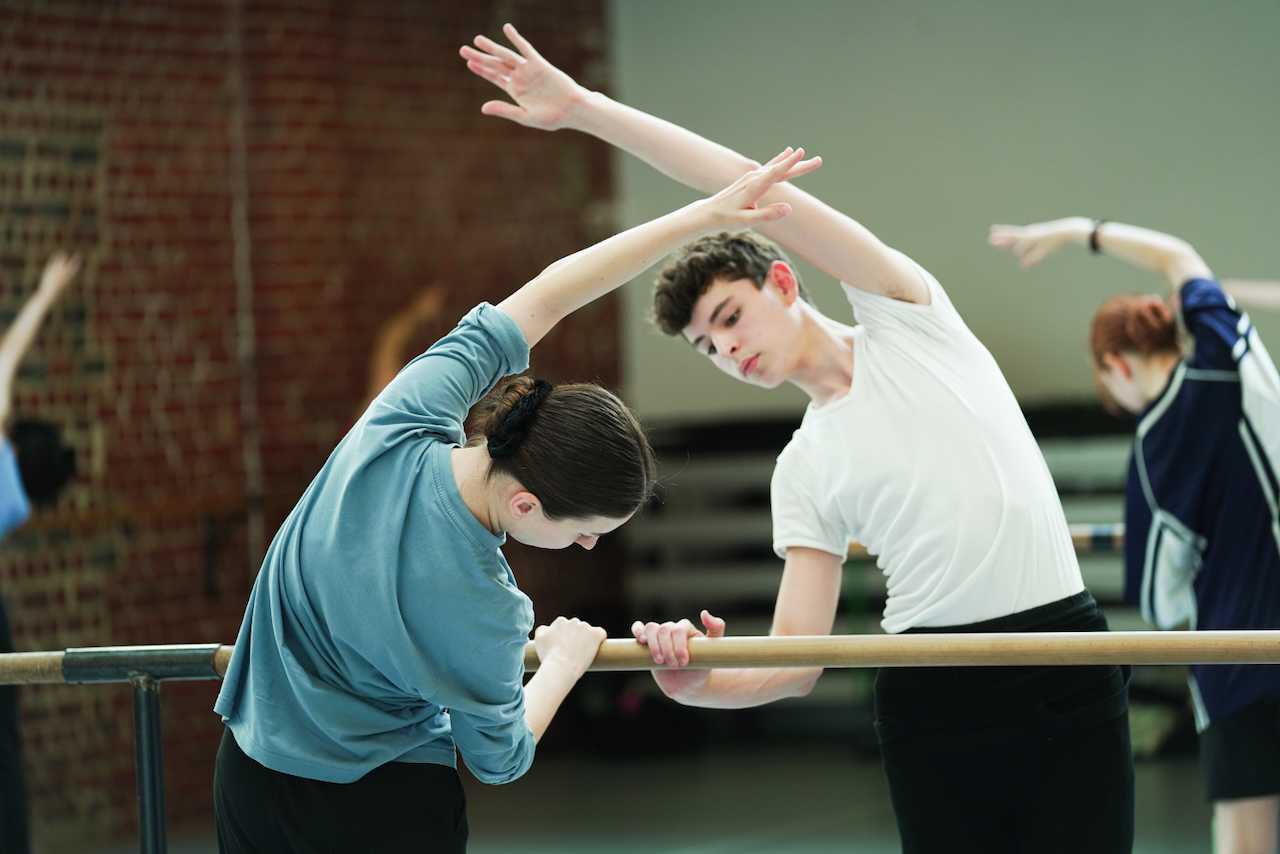
I propose ballet class as a collaborative setting where new information and knowledge about the moving body, in relationship to form and history, happen in the moment. Barre and center combinations are constructed to rigorously support the study of technique as studio practice, accentuating somatic awareness and attention to the multiple perspectives of dynamics alongside varied spatial concerns. We will work on developing an agile relationship between the head, shoulders, arms and legs; considering ballet as art, as a system, and as "changeable architecture". Attention is given to interior mechanics driven by counterpoint. Throughout the class, extensive attentiveness to the musicality of the form gives insight into the various understandings of tempi and interacting rhythms. Combinations and phrase work change depending on both age and desire within the group.
Ballet class - Elementary by Lise Vachon
This class will allow you to explore the fundamentals of Ballet technique, while still being challenged within your own level of experience. We will move through the different elements from working at the barre, to the centre, to travelling across the space, towards turning and jumping. Approaching ballet with a focus on expansion, playing with oppositions, connecting from the floor while finding space and fluidity in the articulations and reaching out beyond your kinesphere. Respecting your instrument while opening new possibilities of expression or sensation through the ballet technique and vocabulary.
Ballet class - Advanced by Lise Vachon
This 2 hour class will give us time to deeply experience the dynamic curves of energy and possibilities within the ballet technique and vocabulary. We will work on allowing the breath to help bring volume and expansion into your dancing, starting from fluidity in the articulations, connecting from the floor and building clear architecture, to reach out beyond the extremities. We will explore suspensions while playing with musicality, to engage with contrasting qualities in the movement combinations, opening the gaze to find freedom, as you travel through the space in multiple directions.
Ballet class by Roman Van Houtven
This ballet class is designed for dancers who have gained some experience in ballet in the past and have a basic understanding of its movement vocabulary, technique and musicality. Throughout the week we will revisit the basic principles of ballet technique and explore how those can be applied to the virtuosic contemporary dancer’s body. We will work on basic anatomy, release, isolation of joints, musicality and efficiently moving our bodies through space. Through all of this, we’ll try to establish how all these elements can strengthen a dancer’s awareness to themselves and how to move through space in a three-dimensional way, while interacting with others.
WORKSHOPS
Workshop Principles of Seutin by Alesandra Seutin
Alesandra Seutin invites participants into the lived experience of her movement practice, where her repertoire becomes a playground for exploration. Centred around her work Boy Breaking Glass (2018), this 3-hour workshop will offer you an opportunity to delve into this multidisciplinary work that encompasses movement, voice and poetry. A full commitment of body, voice, and mind is invited. Moving from practice into creation, you will expand your movement vocabulary, deepen your expressive power, and bring your unique gestural language into the light. Here you will develop a body that is conscious, available, structured yet free, capable of responding fully to music, space, and impulse.
Workshop Rosas toolbox by Clinton Stringer
This workshop offers a deep dive into the compositional systems developed by Anne Teresa De Keersmaeker. Participants will dissect the Rosas methodology through three essential lenses: Generation (strategies for creating original movement); Space (drawing inspiration from patterns in nature, geometry and architecture; how can we manipulate our material spatially?); Time (how can material be stretched, compressed, fragmented or interrupted?). Through guided experimentation, you’ll mix and match these tools to find unexpected results, discovering how to squeeze the maximum creative juice out of a single phrase of movement. Come ready to play, build, and deconstruct.
Workshop Rosas repertory 'Rain' by Clinton Stringer
This Rosas repertory workshop will focus on the material and creative processes behind Rain (2001). We will learn parts of the men’s and women’s materials which each have their specific qualities: sharpness, suspension, organic mechanics... With these materials we will learn some parts of the original choreography and also construct new versions. We will also take some time to study some of the intricate walking and running patterns in the piece.
Workshop Serious Play-Improvisation by David Hernandez
Diving into a daily practice centred around improvisation as spontaneous composition and performance and the concerns connected to improvising. Exploring methods, honing skills, diving deep with playfulness - connecting to the senses and how they nourish us in improvisation. Considering readability and collaboration- performing practice, practicing performing, scoring, and free wheeling. It is a daily rigorous but fun work in order to gain experience and develop the skills of being an improviser. An example of a working day could be starting with an guided open warm up session followed by some more targeted investigations of themes and tools ending with improv sessions where we can implement some of the skills and tools we explored as well as engage in feedback and dialogue based on what we have seen and experienced. There is an emphasis on group spontaneous composition with some exploration of voice work and musicality.
Workshop Partnering by Emmi Väisänen
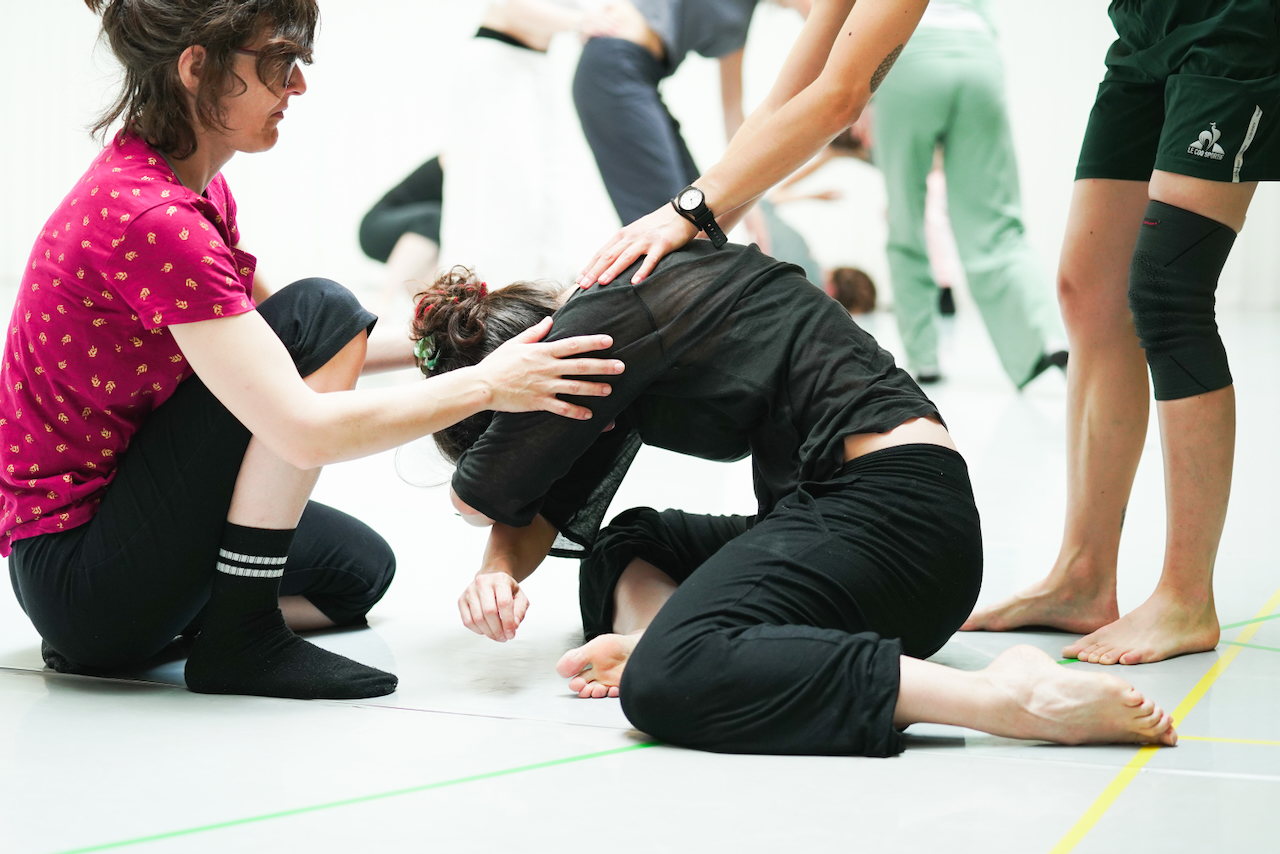
During the week we will deepen awareness of our own bodies through our relationships with one another. We will explore movement as a shared and personal practice, by working in duos as well as individually- with the support of a partner- we will engage in physical training that includes muscle conditioning, fine coordination, task based improvisation and stretching. A partner can help us recognize where we have limitations and patterns and through these discoveries, re-discover ourselves. As the body is complex and partnering requires constant negotiation, refining coordination and bodily awareness in ourselves allows us to become more present and available both for ourselves and for others.
Workshop Sensorial reconnection : a study on interaction by Jason Respillieux
In this movement workshop we will discover how improvisational and compositional tools for dance can be exchanged. Through collaborative practices with all participants, I will guide you through task oriented exercises which enable us to reconnect to our sensorial capacities : to look, to touch, to converse, to hear and to imagine together new approaches to dance. Drawing on the ethics and principles of permaculture, this workshop invites you to introspection, intimate forms of expressions and questions: How do I situate myself ? How do I relate to my immediate and/or imaginary surroundings? This workshop is aimed at anyone who is curious about (re)discovering our senses through learning, observing and interacting with others.
Workshop Rosas repertory ‘A Love Supreme' by Jason Respillieux
This workshop explores the balance between structured material and improvisational freedom. We will focus on learning set phrase work and how to use them as a basis for structured improvisations. Participants will work on connecting with each instrument to develop rhythmic and melodic response to John Coltrane’s most spiritual and influential oeuvre. We will work on incorporating both pre-composed material and open, creative exploration. This repertory workshop will provide tools to integrate improvisation within a structured framework, encouraging personal expression within the work. In relation to these repertory materials, participants must be comfortable with contact and collaborative work.
Workshop Play Full Body by Laura Aris
Play Full Body workshop is both a physical and perceptual journey. It blends playful technical exploration with artistic expression and creative thinking. Participants are invited to shift perspectives and discover new ways of perceiving movement, space, and relational dynamics. While dancing remains at the core, we will also explore the expressive potential of voice, intention, and emotional states as part of performance practice. The work begins with guided improvisations and specific technical exercises. Each day varied tasks are introduced that may initially appear eclectic; however, through clear frameworks and precise attention, participants gradually uncover how different elements connect. Structure acts as a support rather than a limitation, cultivating clarity, safety, and compositional awareness. The work unfolds through solo, partnering, trios, and group situations. Roles often shift between performer, creator, and observer, encouraging reflection and active decision-making. Participants are invited to think in action: to make choices, refine them, and recognize emerging material while working. Practicing a “not-knowing” space: open tasks are approached as a practice rather than confusion. Emphasis is placed on clarity of attention, intention, and action, even when outcomes are undefined. Can imagination be practiced? I believe it can. The creative journey is deeply personal and may include moments of discomfort, fear, or uncertainty. Paradoxically, clear frames and limitations can provide safety and structure, allowing creativity to flourish.
Workshop Rosas repertory 'Drumming' by Laura-Maria Poletti
During this workshop we start by learning the basic phrase underlying the repertory work of Anne-Teresa De Keersmaeker. We will try to understand the basic principles of it and dig into the vocabulary with a great emphasis on details and musicality. We will also go through the choreographic principles of the piece and try to embody them in order to collectively build a composition. And then dance it together and enjoy!
Workshop The Atlas of Interpretation by Manon Santkin
While it is quite obvious that dancing entails moving one’s body, it may be less acknowledged that it also entails shaping and channeling one’s attentiveness. According to where we land our attention, different worlds emerge, providing us with variable invitations to interact with. This workshop is about crafting capacities of perceiving, imagining, and making kin with our field of attention and of potential action. Through embodied explorations, I will transmit a number of key principles to bring awareness on how we pay attention and how that relates with what we feel invited to do. We will approach moving as a situated and reciprocal relationship between the mover and the situations they move with. Therefore, creativity won’t be as much about self-expression but instead it will emerge from the relation between perceiving what is already there and responding to its invitations. It will be an occasion to get acquainted with notions such as affordance, umwelt and situation amongst other things. Throughout the week, we will try ourselves at various « acts of attentiveness » through a selection of guided practices and exercises - of my own and by other artists. You will also play with composing experiments yourselves, for instance by creating personal mini scores for an attentional trajectory. The work will purposely blend different registers of information together, some very concrete, tangible, material and sensory, some more mysterious, subtle, imaginary or intangible. The work aims at cultivating a plurality where different registers of attention do not cancel each other out, on the contrary: they inform poetic expressive situations which are complex. Maybe new encounters with a known place, new continuities. Rather than from an expert point of view, I invite you in this exploration as an artist with a curious body-mind, as sensitive as playful and open to the poetics that may emerge from it. Exploring individually, moving with body, voice and language, sometimes partnering with each other and at times observing each other will make for the richness of our week together. Come as you are, with an explorative mindset preferably.
Workshop Trust the Room, Trust Yourself, Trust the Others... by Marie Goudot
This workshop is based after the performance After Hannibal, which was created last march together with Michael Pomero, Julien Monty, Christine De Smedt, Gilles Almavi & Marie Goudot, and explores how trust can be handled within a group of people. The performance takes its inspiration from a set of improvisation scores developed by Vito Acconci (US, in the 70’, Arte povera artist) that are meant to disrupt perception in order to continuously shift the attention of the performer. Therefore, trust in the room is needed. Through movement, explored in a series of improvisation protocoles, trust is approached not as a fixed state, but as something that is continuously built, negotiated, and embodied—between oneself, others, and the environment in the room. Participants will be invited to engage with different layers of awareness: trusting one’s own physical intuition and decision-making, trusting others in a shared space and trusting the unfolding of the group dynamic. During this shared time, we will create a supportive yet dynamic environment where risk-taking, vulnerability, and attentiveness are encouraged. Participants will explore how to build encounters that challenge habits and develop responsiveness, as well as the ability to act and react. Emphasis will be placed on listening and feedback, and we will develop tools to help recognize our habits within group dynamics. We will approach the space as a site of negotiation, where awareness of others and sensitivity to context shape the emerging content. The workshop focuses on process, relational awareness, and embodied experience. It is open to participants from diverse dance backgrounds.
Workshop Composition 'Mapping' by Roman Van Houtven
In this workshop, students will be challenged to create a personal choreographic solo. As constructing a solo out of thin air isn’t the easiest challenge, several choreographic and compositional tools will be introduced throughout the week. Every workshop day, the students will dive into multiple choreographic and compositional tasks. Based on simple movement or spatial ideas such as numerical systems, music, improvisation or spatial patterns, they will create small and personal phrases. “Mapping” out a variety of possibilities on how to create choreographic work. By the end of the week, the intention is to bring all phrases together in a coherent solo, which could serve as every student’s personal choreographic signature.
Workshop Rosas repertory ‘Drumming’ by Sue-Yeon Youn
Drumming is based on the music of the minimalist composer Steve Reich. The piece is a complex formal construction using a single basic phrase which is transformed in many ways. In the workshop, we will start by learning the base phrase and then explore the principles which were used to construct it. Participants will then make their own transformations of the phrases following the ideas used during the creation. In this process, we will work with techniques such as retrograde and phase shifts, all starting from the same basic phrase but resulting in new and varied transformations. We will also focus on exploring what makes the phrase material specific to the Rosas “style” and how to embody this special quality.
Workshop PLAY SPACE by Susanne Bentley
What makes you unique as a dancer? How can you expand your palette of movement possibilities? What options are there for dancing with others? Play is a state of openness to explore, feel, test, fail, get better… a frame for experiencing the world. Play allows your natural creativity to surface: as John Cleese says, “it’s a relaxed open mode”. The essence of Play Space is to help people connect to their own improvisational movement style & presence. Inspired by Al Wunder’s Theatre of the Ordinary, the work of Andrew Morrish and Ruth Zaporah’s Action Theater, this class promotes an experiential way of learning. Participants discover what they like doing, what they like seeing and take responsibility for noticing and developing their own style of moving and interacting. We start warming up the body using a variety of images and exercises focused towards certain themes for each day. We discover how to generate material instantaneously and explore different ways to interact with others using tools of time, space, rhythm, energy etc. The practice, in small or large groups, also includes learning by doing and watching others. This is an essential part of the process of appreciating each person’s uniqueness as dancers and recognising our aesthetic preferences, to further improve our play experience. Play Space is an environment to recognise your creativity, learn and most importantly, have fun – otherwise why dance?!
Workshop Rosas repertory ‘Fase’ by Tale Dolven
FASE. Four Movements to the Music of Steve Reich. Fase was made in 1982 and is one of Anne Teresa De Keersmaekers most minimalist pieces. The piece consists of 4 choreographies, all different in movements and approach to structure. The students will learn a part of each choreography, each with a different movement focus; walking, arm gestures, swinging and hopping.
Workshop Stepping in and out by Vera Tussing
The material of this workshop will be drawn from what I refer to as the Tactile Cycle of my work – a series of stage performances, installation pieces, lectures & podcasts created over a decade, that focus on tactility, collectivity and consent. The workshop embarks from the question of how to let a singular duet choreography be embodied collectively by multiple couples. In the first half of the week the group will create one set duet phrase for all participants. For the second half of the week, the group will be moving between this phrase and how it can be set into dialog with the whole group. For this dialog to come about we will be exploring different improvisational scores. Asking questions around how we can navigate stepping in and out of the choreography, replacing each other, switching things up, rupturing a connection or picking up the slack.
Workshop The Palm of Your Hand by Vera Tussing
Through my experience as a dancer, performer, director, teacher, and mentor, I have witnessed a growing desire particularly among emerging dancers to engage critically with consent, both in artistic contexts and in society at large. This workshop is designed for dancers and performers who wish to explore touch and its relationship to consent within performative practices, both between performers and in participatory encounters with audiences. Drawing on over a decade of artistic practice centered on tactility and collectivity, I will share approaches developed through works such as T-Dance (2014) The Palm of Your Hand (2015) and many other references collected along the way. Participants will practice maintaining their own boundaries while learning to recognize and respect those of others. We will explore touch as part of processes of consent - spoken, felt, visual, and gestural. Safe words will be used to support a secure environment, and all exercises can be paused at any time to allow for rest or reflection. Sessions will include movement-based practices, guided touch exercises, group discussions, and journaling, supporting participants in articulating and retaining emerging insights and shared principles. Rather than approaching consent as a limitation, this workshop frames it as a generative practice, an embodied way of sensing and creating together while honoring individual differences. English is required and will serve as the shared language for communication throughout the workshop.
Workshop Composition by Youness Khoukhou
This workshop focuses on creating small-scale choreographic compositions individually and in groups. Through guided tasks and structured improvisations, we will generate and shape movement material using different source. We will work with practical compositional tools — timing, space, dynamics, repetition, and variation — to develop short solo and group pieces. The workshop also includes instant composition practice, emphasising real-time d ecision-making and performer awareness.
Workshop Rosas Toolbox by Yuika Hashimoto
This workshop will look closer at the score of Rosas repertoires. How do simple movements become complicated choreography? Where is the movement going and retro grade? This workshop will offer different angles to understand Rosas repertoire work.
Workshop Rosas repertory ‘Rosas danst Rosas’ by Yuika Hashimoto
'Rosas danst Rosas' was made in 1983, and since then 5 different generations of dancers keep dancing till today. We will dive into the choreographic score of 1st and 2nd movements. Being in complete unison, or playing with the counter point. Simple movements into complicated structures..brings you a new way of dancing with others.